
Lakeland Flood Cleanup
Dedicated Emergency Flood Recovery
Living across Central Florida means facing seasonal subtropical downpours and sudden tropical depressions that can overwhelm residential drainage.
Our technicians deliver comprehensive regional emergency water damage restoration services designed to stabilize moisture levels before structural wood rots.
A pattern echoed in public discussions is a resident facing severe roof damage and subsequent interior water intrusion after Hurricane Milton while seeking repair help, emergency tarping advice, and disaster assistance programs.
Another common scenario involves a homeowner experiencing dangerously high indoor humidity and moisture buildup following a storm, asking how to dry out living spaces and prevent mold before power and HVAC are stabilized.
Every mobilization begins with calibrated thermal imaging cameras and deep pin-probe meters to map invisible water tracks behind baseboards.
We coordinate directly with property insurance carriers to document diagnostic moisture logs and ensure swift restoration progress.
Our Four-Step Flood Mitigation Plan
Homeowners often describe dealing with post-hurricane storm damage and rising floodwaters while seeking guidance on cutting out water-damaged drywall, discarding soaked flooring, and treating framing to prevent mold. We coordinate structural drying and help property owners navigate emergency storm damage solutions before framing decays.
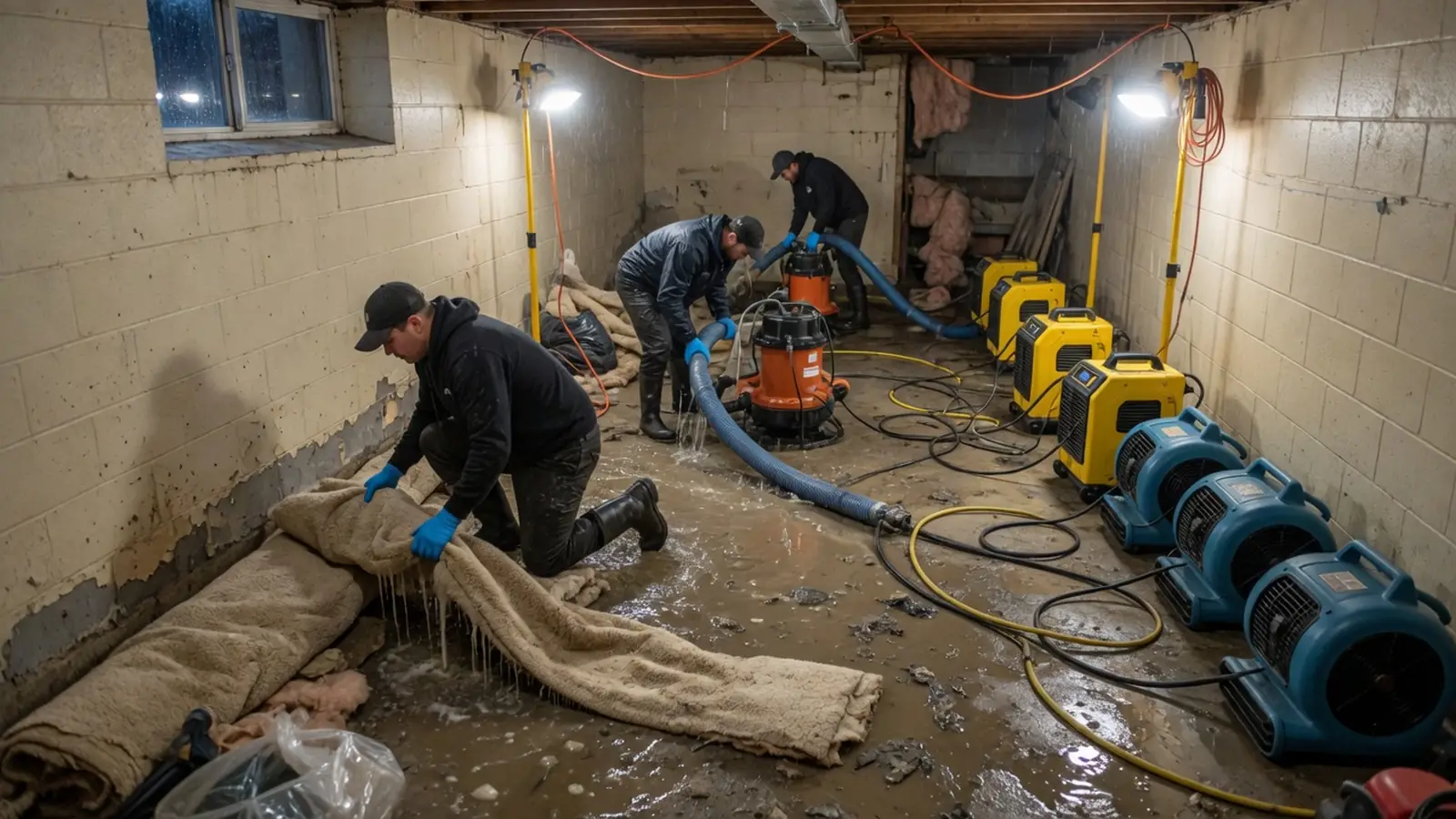
- High-Volume Extraction & Containment. Technicians deploy heavy-duty submersible pumps and truck-mounted vacuum extractors to eliminate standing water quickly. Rapid water removal stops liquid from soaking subfloors and halts moisture migration into adjacent framing plates.
- Flood Line Demolition & Cavity Access. Homeowners cutting flood lines 1-2 feet above the water line after storm flooding uncover hidden mold colonization on the back of drywall and framing studs, seeking DIY vs. pro remediation advice. We make precise horizontal cuts twelve to twenty-four inches above visible moisture lines, strip wet insulation, and expose structural framing studs for direct airflow.
- Commercial Drying & Dehumidification. After mopping up standing water without commercial dehumidifiers or wall cavity drying, a homeowner discovers spreading black mold along baseboards and asks how to properly remediate it. We prevent this failure by installing commercial low-grain refrigerant dehumidifiers and high-velocity axial air movers to draw trapped dampness out of wall cavities and concrete slabs.
- Antimicrobial Treatment & Verification. Technicians apply hospital-grade botanical disinfectant across exposed framing and subfloors while executing certified structural mold remediation procedures to guarantee safety. Digital pin-probe meters and daily atmospheric logs confirm that moisture levels have returned to dry standards.
Our Verified Structural Dry Standard
A homeowner questions whether lingering musty smells and airborne mold symptoms are normal after a water mitigation crew ran fans and completed tear-out following a flood. We hold our work to strict drying standards, deploying calibrated moisture meters, thermal sensors, and relative humidity logs to verify that every wall cavity is completely dry and sanitary before releasing the structure for rebuild.
Emergency Floodwater Extraction
High-capacity submersible pumps and heavy-duty extraction wands eliminate pooling water rapidly from tile, concrete slabs, and crawlspaces. Removing bulk liquid quickly limits wicking into framing and keeps drywall demolition to the minimum necessary height.
AC Overflow & Ceiling Leak Mitigation
A homeowner describes an air conditioner condensate line clog that caused the attic overflow pan to flood, soaking insulation and creating ceiling water stains and sagging drywall. Another homeowner notices yellowing water damage on their ceiling caused by an HVAC condensation leak and asks whether to hire an emergency water restoration company or dry it out of pocket. Our crew clears clogged lines, replaces soaked insulation, and stabilizes damaged ceiling sheetrock.
Structural Antimicrobial Decontamination
Spraying household bleach fails to eliminate deep fungal colonization on porous wall studs and ceiling joists. We treat exposed framing with EPA-registered botanical antimicrobials that penetrate wood fibers, neutralizing microbial growth safely without introducing excess moisture.
Our Commitment To Verified Structural Drying
We measure structural drying using objective psychrometric data rather than guesswork. Every project receives daily monitoring with relative humidity readings, ambient temperature logs, and wood moisture equivalent percentages.
- 14Zip Codes Served
- 4Service Areas
- 3Services Offered
Read direct feedback from local property owners who trusted our crew to extract floodwater, dry saturated wall cavities, and safeguard their homes from mold.
“Every evening before heading out, the crew swept up debris, organized their equipment, and sealed the work zone with heavy plastic barriers. Walking through our hallway without stepping over wet rubble or loose cords gave us tremendous peace of mind during a chaotic week. They showed genuine respect for our living space from start to finish.”
Travis B.
“Daily photo updates and text check-ins arrived every morning detailing the exact moisture levels in our subfloor. I never had to hunt anyone down to find out what was happening or when the dehumidifiers were being checked. The team kept us completely in the loop throughout the entire drying process.”
Valerie P.
“Rather than tearing out all our hardwood, the lead technician explained how focused bottom-up desiccant drying and antimicrobial washdowns would save our original subflooring. Their practical recommendation saved us thousands of dollars in replacement lumber while ensuring the framing remained completely rot-free. It was honest advice that prioritized durability over an expensive upsell.”
Julian C.
“Tropical storms knocked out neighborhood power for two days, stalling our initial extraction timeline. The crew brought in their own heavy-duty generators, reset the drying chamber immediately, and ran extra shifts over the weekend to get our home certified dry on the original deadline. Their determination turned a stressful setback into a complete success.”
Candice M.
Frequently Asked Questions
How high should drywall be cut after indoor storm flooding?
Technicians cut drywall twelve to twenty-four inches above the visible water line to remove saturated materials and expose damp framing studs. This deliberate flood cut prevents water from wicking higher into upper sheetrock, eliminates contaminated wet insulation, and establishes unobstructed airflow for commercial air movers.
Does household bleach eliminate mold from soaked wood framing?
Bleach cannot kill mold on porous wood studs because surface chlorine evaporates quickly while residual water accelerates hidden fungal regrowth. Effective decontamination requires EPA-registered botanical antimicrobials that penetrate deep into the timber grain to neutralize spores without introducing excess liquid.
How long does commercial structural drying take after a flood?
Standard structural drying requires three to five days of continuous operation using industrial dehumidifiers and calibrated centrifugal air movers. Equipment must remain powered on until daily moisture probe readings verify that timber studs and subfloors have reached safe equilibrium moisture content.
How is the cost of emergency flood cleanup calculated?
Mitigation costs depend on standing water depth, the contamination category, affected square footage, and necessary structural drying equipment. Category 3 stormwater runoff requires intensive antimicrobial washing and hazardous removal protocols, whereas clean water intrusions demand fewer labor hours and disposal fees.
Are building permits required for flood damage repair work?
Emergency extraction and drying do not require permits, but structural repairs altering framing, wiring, or plumbing require local municipal permits. Our restoration technicians work directly with local building departments to ensure structural moisture drying is fully certified before reconstruction begins.