
Emergency Water Damage Restoration Lakeland FL
Certified Structural Drying Standards
Our certified restoration specialists provide twenty-four-hour emergency moisture extraction and structural drying for residential and commercial properties.
About 19% of housing units locally (9,791 of 52,137) were built before 1960, the era of galvanized steel supply lines and cast iron drains.
About 10% of housing units in the community (5,385 of 52,137) were built in the 1960s, overlapping the years aluminium branch wiring was installed.
About 37% of housing units across town (19,193 of 52,137) were built in the 1970s and 1980s, overlapping the years polybutylene supply piping was commonly installed.
About 66% of housing units in the market (34,369 of 52,137) were built before 1980, the period when asbestos-containing materials and lead paint were still in use.
Homeowners often describe dealing with post-hurricane storm damage and rising floodwaters, seeking guidance on cutting out water-damaged drywall, discarding soaked flooring, and treating framing to prevent mold.
A pattern echoed in public discussions is that an air conditioner condensate line clog can cause the attic overflow pan to flood, soaking insulation and creating ceiling water stains and sagging drywall.
When unexpected plumbing failures or rising runoff saturate ground levels, our crew provides comprehensive flood cleanup and deep extraction services to halt moisture migration.
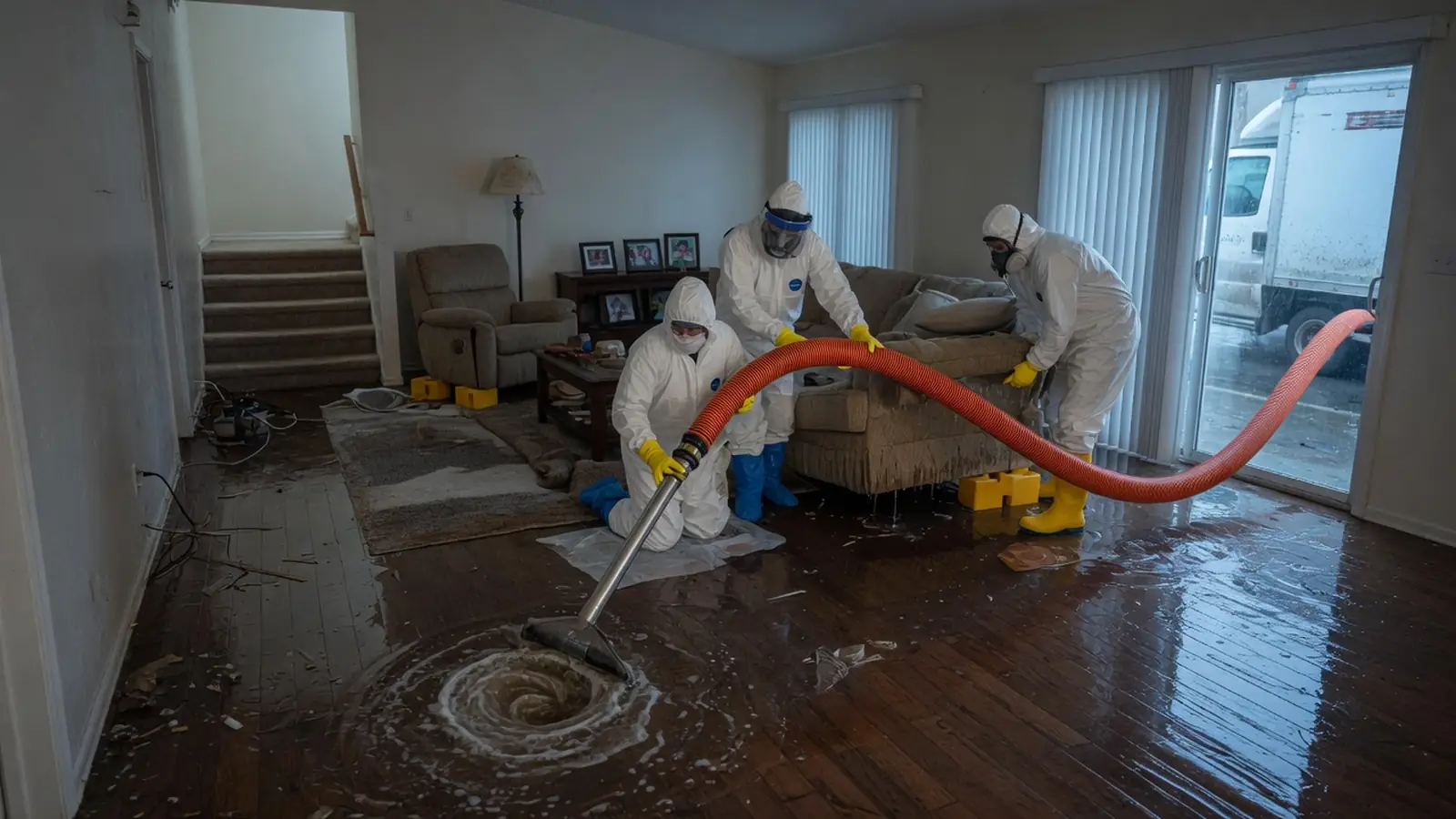
During an emergency callout near Lake Morton, technicians pumped out standing water and set high-velocity air movers to salvage original tongue-and-groove flooring.
Every job concludes with digital moisture mapping to guarantee all structural wall studs and sill plates reach stable equilibrium moisture levels.
How We Dry And Restore Your Property
We follow a rigorous moisture remediation protocol to protect building envelopes, and homeowners facing sudden roof breaches can explore our specialized storm damage restoration procedures to secure their structures.
- Emergency Containment And Moisture Assessment. Storm restoration begins with structural tarping and board-up to halt active rainwater intrusion before structural drying equipment can safely establish a closed drying chamber. Technicians immediately map boundaries with penetrating moisture meters and infrared thermal imaging to document concealed moisture pathways.
- Intrusion Inspection And Attic Assessment. Tropical systems hitting Central Florida frequently drive wind-forced rain through attic ridge and soffit vents, saturating ceiling drywall without obvious initial roof puncture. We inspect roof cavities and ceiling plenums to identify trapped water pockets before gypsum collapses.
- Industrial Extraction And Flood Cuts. We extract bulk moisture using truck-mounted vacuums and perform precision flood cuts above the water line to open damp cavities. Homeowners facing sudden indoor water intrusion often ask what to expect during the restoration lifecycle, including moisture meter readings, equipment run-times, and structural drying stages, which our certified technicians explain before removing ruined insulation.
- Closed-Chamber Dehumidification And Antimicrobial Wash. Commercial low-grain refrigerant (LGR) dehumidifiers and high-cfm air movers circulate dry air continuously to extract bound structural moisture. Technicians apply botanical antimicrobial agents across framing timbers to prevent mold proliferation while tracking daily drying progress.
Certified Structural Drying Protocols
Our restoration approach relies on strict psychrometric science and continuous moisture tracking rather than guesswork. Severe convective weather places severe stress on local properties: NOAA radar recorded 3,046 hail signatures within about 15 miles between 2021-2025 (2021: 393, 2022: 1,011, 2023: 555, 2024: 398, 2025: 689). The heaviest recent hail year around our sector was 2022, with 1,011 radar hail signatures inside a 15-mile radius. When hail or wind creates sudden building punctures that lead to persistent humidity, property owners rely on our certified moisture remediation and professional mold removal services to ensure wall cavities dry safely to baseline levels.
Emergency Water Extraction
We deploy high-volume submersible pumps and industrial extraction mats to remove standing water from slab foundations, crawlspaces, and multi-story buildings within hours of notification. Fast extraction stops water from migrating into subflooring and framing timbers.
Structural Drying And Dehumidification
Using commercial LGR dehumidifiers and axial air movers, our crew establishes controlled drying chambers to pull bound water from concrete, drywall, and structural studs. We monitor ambient psychrometric readings daily until materials return to dry equilibrium standards.
Foundation And Subfloor Moisture Remediation
Subterranean drainage behavior directly influences subfloor moisture dynamics: the dominant mapped soils in our county (FL105) by acreage are Smyrna and Myakka fine sands; Candler sand, 0 to 5 percent slopes; Pomona fine sand; Samsula muck, frequently ponded, 0 to 1 percent slopes. Furthermore, the single most extensive soil unit mapped around our region is Smyrna and Myakka fine sands, covering about 144,718 acres of FL105. Additionally, clay-textured soils account for roughly 9% of the top mapped acreage around the territory (including Hydraquents, clayey). Clay soils change volume as moisture changes, which is the mechanism behind seasonal foundation movement in this area, making rapid subfloor drying vital to preserve structural alignment.
Dedicated Moisture Mitigation Standards
Our certified restoration specialists maintain around-the-clock readiness to halt structural water damage across residential and commercial properties. We combine advanced diagnostic thermal cameras, industrial drying equipment, and daily moisture logging to return your property to safe dry standards.
- 14Zip Codes Served
- 8Service Areas
- 3Services Offered
Here is how real local property owners describe our emergency extraction, structural drying, and mitigation response:
“Every evening before packing up, the crew swept our hallways, stacked their cords neatly, and sealed the containment plastic tight. They made sure our family could safely access the rear bedrooms without stepping over wet debris. That tidy daily routine kept our household calm during a stressful flood drying process.”
Marcus B.
“When our upstairs bathroom supply line ruptured on a Sunday afternoon, this company picked up immediately and dispatched technicians to our door. The technician answered all my frantic questions about our hardwood flooring and stabilized the leak before water migrated downstairs. Having direct communication over the weekend saved our subfloors from total ruin.”
Elena V.
“What impressed me most was the precision of their flood cuts along the base of the drywall. The team snapped clean chalk lines exactly sixteen inches up and left the wall studs completely flush and level for sheetrock reinstall. You can tell they take true pride in structural prep rather than just hacking away at wet gypsum.”
Darren K.
“After seeing how effectively they dried out our crawlspace and subflooring, I passed their phone number to my coworker whose water heater had just flooded her laundry room. She hired them the following morning and called me to say how relieved she was with their prompt work. Recommending them was an absolute no-brainer.”
Brenda T.
Frequently Asked Questions
Can water extraction and structural drying proceed if hurricane winds knock out electrical grid power to our neighborhood?
Yes, our emergency fleet operates commercial high-capacity mobile generators to power extractors and drying equipment during grid power blackouts.
How soon must structural water extraction begin after an indoor pipe burst?
Water extraction should begin within twenty-four to forty-eight hours to prevent microbial growth and irreversible structural drywall damage.
Can a homeowner rent air movers instead of hiring a restoration crew?
Renting consumer fans rarely pulls trapped moisture from behind wall cavities, leading to persistent rot that professional LGR systems prevent.
How do technicians verify that structural framing is completely dry?
Technicians compare daily penetrating moisture meter and thermal imaging readings against unaffected baseline materials until dry standards are met.
Does insurance require testing older homes before drywall demolition?
Buildings constructed before 1980 require lead and asbestos screening before aggressive demolition to protect indoor occupants and workers safely.